

In the US, one person dies every 33 seconds from cardiovascular disease. Coronary artery disease (CAD) is one of the most charted medical conditions in the American healthcare system. Due to the massive volume of patients, this condition is one of the most audited and scrutinized services, resulting in claim denials and lengthy appeal process to recover revenue.
Under the new payer reimbursement guidelines, your clinical documentation must include clear pathology along the ICD 10 code for CAD with angina (I25.110, I25.119), etc. Vague dictation notes are now invalid, prompting cardiologists to add relevant details to support the insurance claim like stable, unstable angina, ejection fraction variation, etc. Audit-ready clinical charting and documentation is not just necessary, it also safeguards your revenue. With the advent of AI scrubbing tools and extensive payer oversight, bridging the documentation gap in your cardiology billing ensures your practice consistently provides best quality cardiovascular care.
The Core CAD Code Breakdown: Beyond Unspecified I25.10
Understanding the use and limitation of atherosclerotic heart disease icd 10 code is vital to for maintaining compliance with payer regulation:
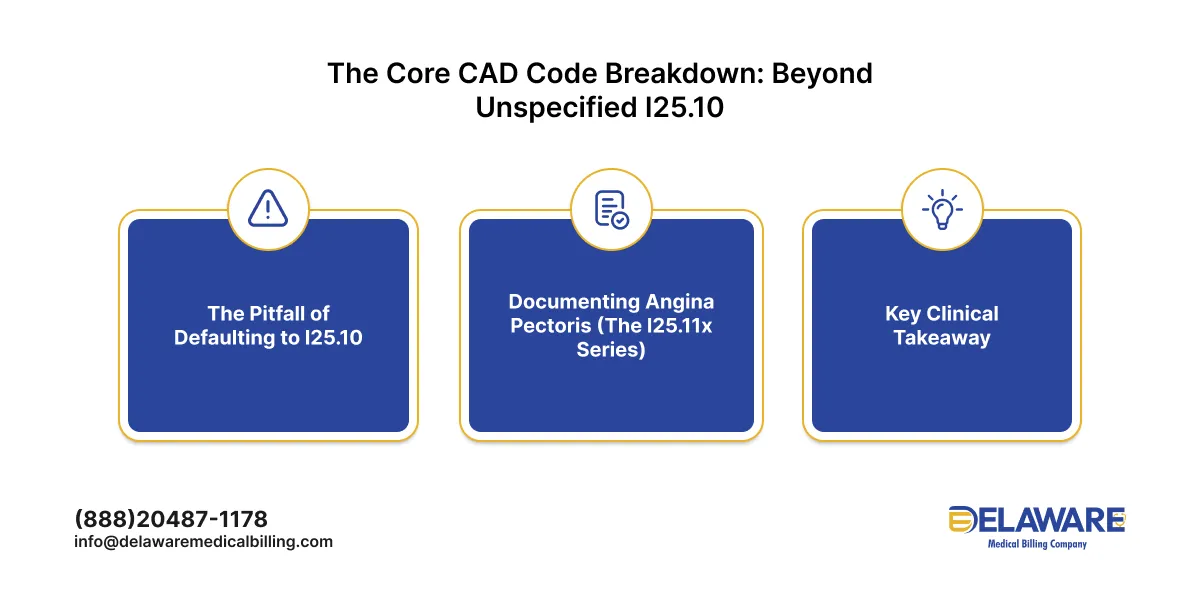
The Pitfall of Defaulting to I25.10
Many practices opt for the common EHR shortcut of using I25.10 (Atherosclerotic heart disease of native coronary artery without angina) for ease. In 2026, Medicare and commercial payers see it as unspecified and incomplete, requiring further probing. When cardiologists frequently use icd 10 code for cad without angina (I25.10) for every patient, payers flag such claims for missing or insufficient advanced diagnostic testing, which increases the risk of claim denial.
Documenting Angina Pectoris (The I25.11x Series)
Under the new cad billing and compliance guidelines, diagnosis of Angina pectoris must be linked to coronary artery disease. The use of I25.11x series codes help providers in capturing the critical condition of the patients:
Unstable Angina (I25.110)
This ICD-10 must be used when the unexpected chest pain is present, even when the patient is resting.
Angina Pectoris with Documented Spasm (I25.111)
Use this code when documenting angina in coronary artery disease progress notes when the patient is experiencing vasospastic or Prinzmetal’s angina.
Other / Unspecified Forms of Angina (I25.118 / I25.119)
Use this ICD 10 code When the angina is stable or exertional symptoms are documented. Specifying the severity and complete description of the angina and its type help practices understand the medical rationale.
Key Clinical Takeaway
If the patient is experiencing angina, it must be documented in the assessment along with the complete detail of artery location. If the link between the symptom and the assessment plan is not established, payers will think the angina is not present, downcoding every service you provided for the angina treatment, leaving you underpaid or outright denying the claim.
Surgical History & Graft Status: Where Most Denials Happen
Accurate coding CAD with bypass graft vs native vessel is essential for faster claim processing. Here the breakdown of how to document invasive procedures:
Native Vessels vs. Bypass Grafts vs. Stents
Documentation for invasive procedures performed on native coronary vessels via bypass grafts and stents mandatory for clinical documentation improvement (CDI) for CAD. Majority of claim denials occur when practices fail to document procedures involving a native artery or a graft.
Autologous Vein Grafts (I25.810)
Autologous vein grafts must be documented using I25.810 to specify that the vein was taken from the patient’s own body. Failure to add such details trigger claim denial.
Nonautologous/Biological & Arterial Grafts (I25.811 / I25.812)
For non-autologous or biological graft use the code I25.811 and for arterial graft I25.812 to ensure coronary artery disease medical necessity documentation are spotless.
The Role of Stents and History Codes
Cardiology billing team often confuse the active disease management with procedural history, leading to payer audits:
Active Vessel CAD vs. In-Stent Stenosis
Your documentation must differentiate active CAD from in-stent restenosis using (I25.118 / T82.858A) codes.
Secondary History Z-Codes
Use ICD 10 z-codes for cardiac history for CABG history with Z95.1 (Presence of coronary artery bypass graft) or Z95.5 (Presence of coronary angioplasty implant and graft) to safeguard your revenue.
Post-Procedure Progress Note Checklist
Your post-procedure progress notes must answer the three core questions:
- Is current CAD located in native arteries, bypass graft or in stent location.
- By pass graft is autologous vein, arterial, or biological.
- Procedural history Z-codes (Z95.1 / Z95.5) active or not.
Addressing these questions help interventional and cardio-thoracic practices reduce denials and keep cash flowing through timely submission.
Addressing Common Payer Red Flags & Audits
By addressing the common reasons for payer audits, RCM teams can know how to prevent icd 10 claim denials for cardiology claims.
Lack of Etiology‑Manifestation Linkage
Claim denials are often triggered when practices fail to establish a solid link of Coronary Artery Disease (CAD) with comorbid conditions like hypertension, congestive heart failure, diabetes, etc. Without establishing a causal relationship, payers flag the claim as inconsistent and initiate audit.
“History of CAD” vs. “Active CAD”
Your coding charts must accurately document if the coronary artery disease is active disease management or a past history item. If the patient is on medications like antiplatelets, statins, antihypertensives, etc then your documentation must show active chronic condition and medical management. Missing these details creates compliance gaps and exposes your revenue cycle to clawbacks, audits and penalties.
Documentation Best Practices for the Progress Note
Here’s how you can make your documentation audit-proof:
Subjective/Objective
You must document angina frequency symptoms, functional class (NYHA or CCSC classification) along with cardiac cath and stress tests like ECHO, ETT, etc.
Assessment & Plan
Link the medical intervention and medications such as beta-blockers, statins, antiplatelets, antidiabetic and antihypertensives directly with the CAD diagnosis.
Conclusion
ICD 10 codes for CAD require precision at every step to ensure treatment provided aligns with the coding requirements. Mastering the clinical documentation ensures your diagnosis, treatment and claim speak the language. The steps we mentioned above help you improve the documentation practices, making the revenue cycle audit-ready.
Is your cardiology practice facing claim denials, inconsistent cash flow and payer audits? Outsource your billing to Delaware Medical Billing to reduce administrative burden and improve results.