
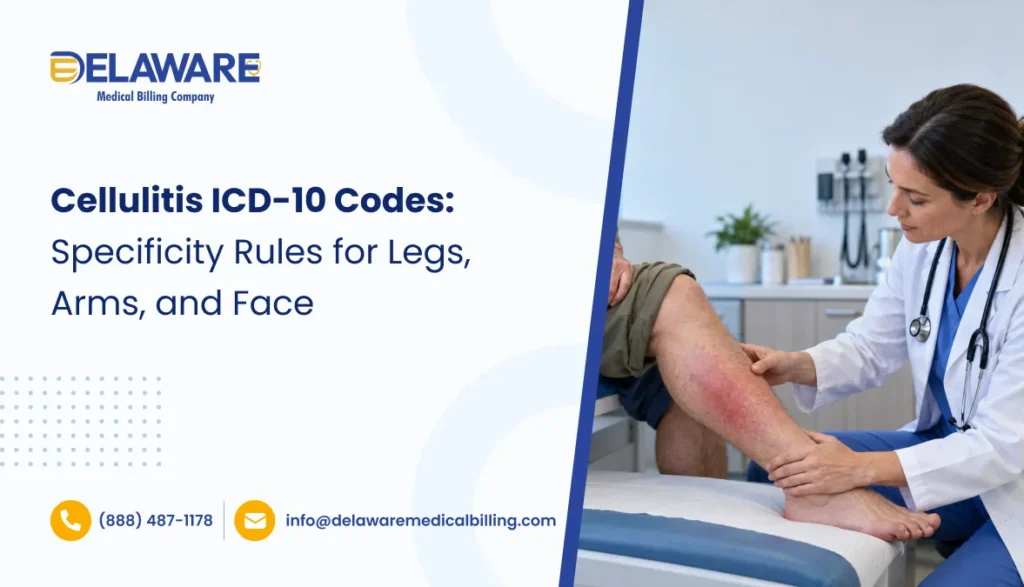
In dermatologic diagnosis, non-specific ICD-10 coding frequently triggers billing delays, administrative CDI queries, and costly claim rejections. Cellulitis commonly known as the bacterial infection of the skin is frequently treated at outpatient and inpatient settings, and majority of the billing mistakes related to this disease stem from imprecise clinical documentation. When practices fail to add specificity in charting, this prompts medical coders to rely on generic “unspecified” codes, resulting in payer scrutinies on every claim having cellulitis ICD-10 code.
This blog highlights the specificity requirements for cellulitis of the legs, arms, and face, so the providers can strengthen the cellulitis laterality documentation for higher clean claim rate. By integrating diagnostic precision, dermatology clinics can streamline reimbursement and reduce avoidable billing complications.
Why Specificity Matters in Cellulitis ICD-10 Coding
It’s imperative for healthcare providers to understand bilateral cellulitis coding rules to improve the financial yield of every claim they submit to payers.
The Cost of “Unspecified” (L03.90)
When healthcare providers overly rely on unspecified cellulitis ICD-10 code (L03.90), they expose their practice to unnecessary payer scrutiny. When the patient documentation supports more precise diagnosis, it’s essential to add specific code for the infection site. Unspecified cellulitis L03.90 claim denials are the biggest contributor to low collections.
Clinical Documentation vs. Coding Rules
It’s important to know that the medical coders cannot assume the clinical context of the encounter unless the provider adds relevant details in the clinical notes. Documentation must clearly distinguish acute vs chronic skin and subcutaneous tissue infections, and exact anatomical sites. Accurate medical billing and coding for dermatologic infections ensures providers get reimbursed for full value of the service.
Key ICD-10 Guidelines
L03 category codes require explicit localization details like exact sub-sites and laterality to avoid CDI queries for skin infections and maintain coding compliance.
Anatomic Site Specificity Breakdown
Achieving higher clean claim rate is contingent on the documented anatomical site and, for extremities, laterality. When the providers precisely identify where the skin infection is located, coders can easily apply accurate cellulitis ICD-10 code based on anatomical region, laterality, and underlying etiology. The following categorical breakdown helps practices to take corrective steps to improve clinical documentation.
A. Lower Extremity (Legs & Feet) – Category L03.11
Cellulitis of lower limb ICD-10 codes are of three types, each used to help payers understand the anatomical region of lower limbs.
Primary Codes:
- Right lower limb: L03.115 ICD-10 code (cellulitis of right lower limb)
- Left lower limb: L03.116 ICD-10 code (cellulitis of left lower limb)
- Unspecified lower limb: L03.119 (Cellulitis of unspecified lower limb)
Documentation Rules for Providers
Chronic vs. acute cellulitis documentation must clearly specify laterality (right vs. left) and exact anatomical boundaries (e.g., thigh, calf, ankle, or foot).
Pitfalls to Avoid
When the laterality is missing from provider notes, medical coders have left no choice but to use L03.119, triggering immediate claim denials. Additionally, failing to document underlying conditions such as venous stasis ulcers, diabetes mellitus, or lymphedema prevents comprehensive support to medical necessity for cellulitis diagnosis.
B. Upper Extremity (Arms & Hands) – Category L03.12
Cellulitis of upper extremity ICD-10 coding also depends on precise laterality and anatomical localization from the shoulder down to the digits.
Primary Codes
- Right upper limb: L03.125 ICD-10 code (cellulitis of right upper limb)
- Left upper limb: L03.126 ICD-10 code (cellulitis of left upper limb)
Documentation Rules for Providers
Clearly identify whether the upper limb infection involves the upper arm, forearm, hand, or fingers beside the severity of the infection.
Clinical Context
Must document the underlying or primary cause for infection like insect bites, superficial abrasions, or IV site complications, etc to enable secondary coding that supports higher severity of illness (SOI) scores.
C. Facial & Head Cellulitis – Category L03.21
Facial cellulitis ICD-10 codes are used for the treatment of head and neck soft tissue infections. Periorbital vs. facial cellulitis coding carry elevated risks for severe systemic complications, payers strictly enforce documentation standards for Category L03.21.
Primary Codes
- Face: L03.211 (Cellulitis of face)
- Neck: L03.221 (Cellulitis of neck)
Documentation Rules for Providers
Providers must clearly distinguish facial cellulitis from preseptal or orbital cellulitis (H05.011-H05.019), as mislabeling these conditions drastically alters both clinical management and coding assignment.
Best Practices to Avoid Claim Rejections & CDI Queries
Implementing structured provider clinical documentation guidelines hinges on solid protocols to protect practice revenue and prevents costly administrative delays associated with selecting a non-specific cellulitis ICD-10 code.
Apply the Laterality Rule
Provider notes must explicitly detail the laterality of the anatomical site treated like right, left, or bilateral involvement when clinically applicable. Omitting side-specific details remains the leading cellulitis claim rejection causes.
Identify Causal Organisms
When culture results identify an infectious organism, providers must start documenting infectious agent B95-B97 codes for specifying pathogens such as Staphylococcus or Streptococcus for document complete clinical picture.
Capture Comorbidities & Risk Factors
Link underlying medical conditions like diabetes mellitus, peripheral artery disease (PAD), or immunosuppression to support medical necessity for advanced treatment, observation, or inpatient admission.
Optimize EHR Smart Templates
Add mandatory fields in EHR clinical templates for clinical documentation improvement (CDI) cellulitis. EHR templates must include detailed prompts for anatomical sub-site, laterality, and underlying etiology before signing notes help providers to make the claim bullet-proof against payer scrubbing tools.
Conclusion & Actionable Takeaways
The selection of accurate Cellulitis ICD-10 Code begins when the provider and coder have clear communication. Achieving clean claims in medical practice billing is only possible when provider notes clearly identify the affected leg, arm, face, laterality, and relevant underlying cause to support medical necessity. When healthcare facilities follow precise documentation, it ensures seamless compliance and rapid reimbursement across outpatient and inpatient care.
Before signing your clinical notes, remember the ultimate formula for reimbursement success: Laterality + Exact Site + Underlying Cause = Clean Claim. Implementing this simple standard protects your practice from preventable denials and elevates overall clinical documentation quality. By following this simple yet effective protocol, you can minimize the negative reimbursement impact of unspecified ICD-10 codes on your revenue cycle.
Having issues with your dermatology claims? Contact Delaware Medical Billing to reduce administrative burden and non-compliance. Get your free revenue cycle audit today.